Tuesday, May 24, 2016

7 Cool Things We Never Knew Lavender Could Do

Add this wonder plant to your farmers’ market shopping list.


Maybe you’re thinking of planting lavender because it’s a beautiful addition to any flowerbed and because bees seem to love it. But its usefulness doesn’t stop there. Here are seven ways to put it to work at home outside or in an indoor herb garden.
1. Keep Moths Away
Dried lavender is a popular natural alternative to mothballs, which contain toxic pesticides. The scientific data is a little sparse, but one study did find that lavender essential oil was an effective insecticide against a specific type of moth larvae (orgyia trigotephras, to be exact), so we say it’s worth a shot. Fill small sachets with dried lavender and keep them tucked in your closet and wardrobe. Moth problem or not, these pouches will do double duty by leaving your clothes smelling fresh and clean.
2. Make A Fragrant Wreath
In aromatherapy, lavender is used to relieve anxiety and boost mood, so keeping it around the house may help you to relax after a long day. Incorporate it into your décor by learning How To Make A Lavender Wreath that will freshen the air and add charm to any room.
3. Sanitize Hands
Lavender essential oil has antibacterial properties, making it a popular ingredient in many organic and homemade hand sanitizers. You can find lots of DIY recipes online, many of which include aloe vera gel and witch hazel in addition to lavender oil.
4. Clean Up Contaminated Soil
Several studies have found that planting lavender is an effective way to restore contaminated land, such as former mine sites, because it removes heavy metals and other pollutants from the soil. Even better, these contaminants don’t affect the quality of the lavender plant or its essential oil.
5. Make A Mean Lemonade
Lavender is the secret to ultra-refreshing, lemonade. Simply blend lavender and sugar together before mixing with water and lemon for a floral infused thirst-quencher that’s naturally pinkish-purple in color.  
6. Take An Aromatherapy Bath
We’ve already mentioned lavender’s soothing effect, and the best place to take advantage of it is in the bathtub. Whip up an easy batch of rosemary-and-lavender bath salts in your stand mixer with homegrown or farmers’ market herbs for a therapeutic soak. Or add it to a homemade shampoo. Bonus: Treat your body to a rub with healing Tulsi Luminous Lavender and Pink Sea Salt Body Scrub
7. Help You Sleep
Science confirms what people have known for centuries: The scent of lavender has a soothing, sedative affect that can help you get to sleep. Make a tea with the flowers before bed or stuff a lavender sachet inside your pillow to help you on your way to sweet dreams and kiss the melatonin pills goodbye. 

"I Tried Oil Pulling For A Month And This Is What Happened"

Can you swish your way to healthier gums and a calmer mind?


The practice of oil pulling is said to whiten teeth, treat gum disease, clear up acne, fight migraines, cure jaw pain, purge toxins, and improve overall health and well-being, but that’s not why I tried it. In fact, I didn’t know any of these “promises” when I started swishing oil around in my mouth. I did it because my yoga teacher, Lorilee Gillmore, recommended it. Not only is she a kick-ass yoga instructor and owner of Phoenix-based Moksha Ayurveda, (a center for the ancient science and medical arm of yoga dating back more than 3,000 years), she's also the picture of health and happiness. “Ama, which is known as toxicity in Ayurveda, builds up on the mouth and tongue,” she explained one day. “Oil can pull the toxicity out of the mouth.” I was game. I got started the next day, and almost a year later, I'm still going strong.
Not that it was love at first swish. The mouth feel of oil isn’t silky like wine, and that first tablespoon of olive oil was like gargling with grease, but still I swished and swished for what felt like forever. Four minutes in, I’d had it and couldn’t spit the oil out fast enough. The next day, I switched to cold-pressed organic coconut oil, which made all the difference. Any vegetable cooking oil will do—sesame, sunflower, grape seed—so go with the one you like best, and opt for a high-quality organic version, because you are using it as medicine, says Lorilee. (We like Organic Coconut Oil.)
I kept at oil pulling, and before I knew it, 4 minutes every day stretched to 15, and my gag reflex turned off. But even better, the swish turned meditative. Instead of trying to talk with an oil spill in my mouth—which, spoiler alert, is nearly impossible—the silent morning ritual became akin to a killer meditation session. My kids quit asking me questions when they saw my pursed lips, and the ocean-like sound of the swishing worked like sound therapy on my monkey mind. And yes, my teeth felt cleaner and looked whiter, but that was just the icing on the cake. 
About a month into my new habit, I went for my regular six-month dental checkup and nailed my periodontal exam. You know, when the hygienist pokes and probes your gums, firing numbers to correspond to the bone loss around each tooth. The 1's, 2's, and 3's are no biggie, but when you get into the 4's and 5's, it can mean the beginning of periodontal disease—and I always used to have 4's and 5's. But not this time. Even the hygienist seemed surprised by my numbers, so I told her about oil pulling, and even though the dental community hasn’t embraced the holistic practice, the hygienist seemed intrigued. (“Based on the lack of currently available evidence, oil pulling is not recommended as a supplementary oral hygiene practice and certainly not as a replacement for standard, time-tested oral health behaviors and modalities,” says the American Dental Association’s website.)
Some say the oil works like a magnet on bacteria and plaque, sucking them out of oral hiding spots, but there’s no proof yet that either bacteria or plaque are fat soluble and cling to swished oil. Others claim the act of swirling turns the oil into a kind of soap for the mouth, leaving it squeaky clean. The science isn’t definitive, but preliminary studies show it can reduce plaque and cavity-causing bacteria. 
These days, my routine is simple. I do my oil pulling first thing in the morning, before coffee or teeth brushing. Sometimes I swish for 5 minutes, sometimes 20, depending on my schedule that day. Then I spit the oil in the garbage (no sense clogging my kitchen or bathroom drain). Gillmore has her own style: “I do my pulling while I’m in the shower. I tongue scrape, floss, and take a big swig of organic sesame oil before I get in, and then I work the oil in my mouth while I shampoo, condition, and shave.” It’s her version of singing in the shower.


Plant The Seed: A Potless Approach to Spring Gardening

In your garden, do you want stronger plants, earlier blooms and a longer growing season? Then start your seedlings inside! Wind, rain and the occasional hailstorm can damage sensitive young plants, making them weak and potentially killing them. Your dreams of turning your neighbors green with garden envy will die along with your seeds. So, purchase a few seedling bags from your local nursery or grocery store, and follow these best practices for a better garden.
Photo: Seakettle
Best Practices to Plant Seeds:
  • Plant your seeds three times as deep as the size of the seed.
  • Water them early and often.
  • Put them in a warm, well-lit space with natural light until they sprout.
  • Don’t transplant a seedling until it has grown at least two “true leaves,” the leaves resembling the parent plant. The first leaves your plant will sprout are just seed leaves, which supply nutrients to the young plant.
  • When your seedlings have grown about 3 inches, they’re ready to be transplanted.
Seedling Planter Options:

Eggshells 

Save your shells! They can be used to plant seeds. First, crack the eggs carefully to ensure that more than half of the shell is still intact. Clean the eggshell so it’s empty. Be careful! Eggshells are fragile and will break under pressure. Plant the seeds you’ve chosen according to the packages’ instructions. To keep track of your new seedlings, use wooden coffee-stirrers to label what you’ve planted.

Tea Cans

Old tea cans work well as seedling planters. If drinking that much tea isn’t appetizing, scour your local thrift store. Vintage tea cans often show up as decorative items. Clean your cans thoroughly, and then plant the seeds you’ve chosen according to the packages’ instructions. Because tea cans are deep, you will need more potting soil than you would with eggshells.

Citrus Peels

Cut your citrus in half, and thoroughly clean the fruit out of the center. Eat it. You only want the peel as a planter. Drill a small hole in the bottom of the citrus with an ice pick for drainage, and then plant your seeds according to packages’ instructions. Bonus: You can plant the peel right along with the seedling!

Toilet Paper Rolls

Americans use an average of 23.6 rolls per ca-pita a year. Instead of throwing them away, use them to plant! Cut your toilet paper rolls in half. Place your halved rolls in a plastic or wooden container. We recommend you write your plants’ names directly onto the toilet paper rolls with pen before you start planting. When you’re ready to grow your seedlings, follow the instructions on the seed packages you’ve chosen. Be sure to only sow one seed per roll. When you’re ready to plant in your garden, you can plant your toilet paper roll, too! It will decompose.

Sprouting 101, Homemade Sprouting Jars {tutorial}


Sprouting always brings back memories of my childhood when my mother sprouted her own seeds and legumes and made homemade yogurt.  It felt to be a cross between a frugal-DIY effort and a vestige of a more hippie-laden time.  Regardless of motivation, it was standard practice in my household.  Fast forward to now when home crafting of food has taken the place of the chic that purchasing everything held a mere decade ago.  Now if you are cool, you brew you own craft beer, make your own wine, can the vegetables you’ve grown in your own community garden plot and cook from scratch whenever possible.
Sprouts and micro greens are commonplace in most markets, with the most exotic varieties such as sunflower sprouts no longer raising an eyebrow from discerning shoppers.  I love a good sprout addition to a sandwich or salad, savoring the crunchy texture, the playful visual addition, and the nutrition packed source available on-the-cheap when spouting at home.
It is so simple it seems a shame to pass up spreading the word.  My recent review of DIY Mason Jars brought the topic front and center as the book shares a project of homemade Sprouting Jars.  Much more fun visually than my mother’s sprouting jars, these are fashioned from quart size Mason jars and colorful, plastic needlework canvas from the craft store.  They are quick and easy to make, fun to use and happy to have around your kitchen.
Why sprout?  There are many varieties of seeds and legumes which can be sprouted offering a plethora of options for any dishes.  Sprouts contain a significant amount of nutrition in their tiny form offering the opportunity to boost a meal with their simple addition.
What to sprout?  When choosing seeds to sprout purchase seeds designated for sprouting versus for planting to ensure they are edible.  I also have sprouted actual sunflower hulls which are crunchy and delicious.  Most grocery stores have a selection of sprouting seeds near the produce department.
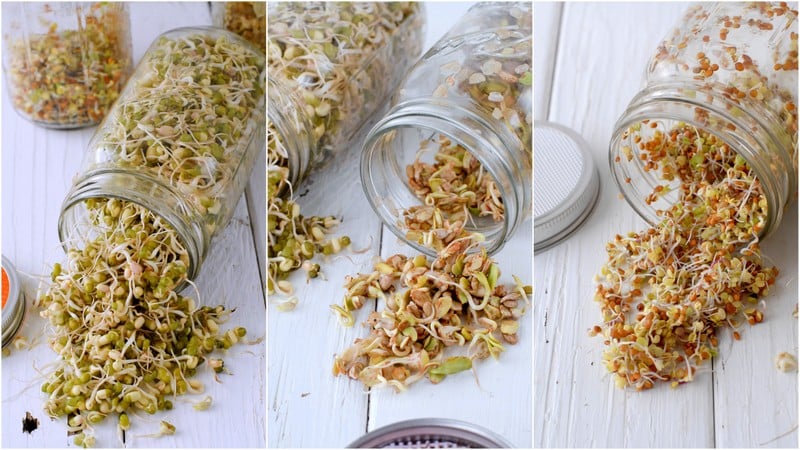
How to sprout?  All seeds have different sprouting time frames that range from 2 days to a full week.  In a test sprouting I did for this post the mung beans began to sprout in about 2 days and had filled the Mason jar within 4 days.  The other sprouts ranged to be close to that or a few days longer.
Making Sprouting Jars {a project from DIY Mason Jars}
Supplies:
  • Quart-size Mason Jars
  • Sharpie or another marker
  • Plastic needlework canvas
  • Scissors
  • Dried seeds or beans used for sprouting
SUPPLIES to make Homemade Sprouting Jars and for sprouting.
Plastic needlework canvas used to create a screened airflow for sprouting jars may be purchased at hobby and craft stores. These colorful sheets cost $0.59 each providing a sprouting jar can be created for less than $2.00/jar. The canvas comes in many colors and sizes as noted by the variations on the left.
STEP 1: Trace the lid of the jar onto the plastic canvas. Consider using varied canvas sized to allow sprouting of even very small seeds. Cheesecloth also may be substituted when sprouting very small seeds.
STEP 2: Cut out traced canvas circles(s). Insert them into the Mason jar lid ring (do not insert the metal inner circle into the lid ring; only the canvas circle). Screw lid onto quart Mason jar.
Completed sprouting jars.
How to Sprout!
Once you have created your sprouting jars, place 2 tablespoons to the ½ cup of sprouting seeds in a given jar depending on how large a crop you wish to have.  I used ½ cup of mung beans which created a quart of sprouts; maybe a bit much for a starter batch.  You can experiment with the amounts until you decide what works for you.
{Tutorial} Sprouting 101 | BoulderLocavore.com
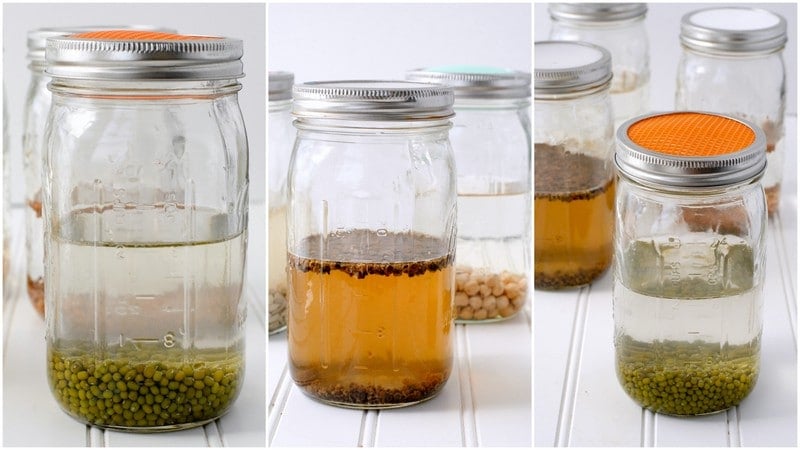
Many different seeds and legumes may be used for sprouting though ensure they are sold for sprouting and contain no pathogens. Mung beans (left), beet seeds middle.
Seal the jar with the screen lid.   Fill the jar with water to cover the seeds plus an inch.  Allow them to sit in a cool spot, out of direct sunlight overnight.  Drain the water through the screen top.   Place the jar on its side again in a cool spot out of direct sunlight.
Rinse the seeds twice daily by filling the jar to cover the seeds, swish the water around to rinse all the sprouts; drain through the screen top and replace on its side until the sprouts have grown to the size desired.
Once the sprouts are finished, remove them from the jar, place in a plastic bag or sealed container in the refrigerator to use.  Sprouts should stay fresh for up to a week.
Disclaimer: (Sprouting Seeds)  Following the publishing of this post it has been brought to the author’s attention there are concerns regarding  unsanitized sprouting seeds creating the exposure for E Coli and Salmonella when sprouting.  Before sprouting your own seeds, please research to make your own decision on pre-sanitizing seeds before sprouting and proceed at your own risk.  The author cannot be held responsible for any adverse reaction to home sprouted seeds.
Sprouting 101{tutorial} | BoulderLocavore.com
After 4 days: Mung bean sprouts (left), sunflower seed sprouts (middle), radish sprouts (right).

How To Make A Soap Dispenser Right

This transformation is complete in about five minutes flat, and if you use a nice-colored natural soap like this, looks beautiful next to the bathroom or kitchen sink. Love Grows Wild provides two different methods for making the soap dispenser and getting that pump attached just right.

Plant A Terrarium In A Jar


How To Plant a Terrarium in a Jar


We're pretty into plants around here and have a lot of experience with succulents and container gardens. Beautiful terrariums keep popping up online and out in the world and we've been lusting after them, wanting to make one but for some reason found the whole idea of building a terrarium a little daunting. It seemed like you needed all sorts of fancy stuff and...magic? But last week we finally took the plunge and started small, creating a sweet little terrarium out of a jar we found at the salvation army:
Gather Your Supplies:
- a jar or other container that is mostly contained
-some rocks
-charcoal (this is the fanciest ingredient)
-some dirt
-some plants
-options: some moss
Assemble:
This is the easy part. Once you have your supplies, lay some rocks in the bottom of your container. These are for drainage. Then sprinkle in some charcoal. This helps absorb the decaying matter that will be created within the terrarium. We got ours at the nursery, so you don't need to make any special trips for it. Then sprinkle in some soil and start planting. We chose succulents for our little guy and relied on using cuttings from plants we already had around. We decided to add some decorative moss to make it feel more terrarium-y (and we found it at OSH, so you don't have to go out of your way to find it).
We watered it and sealed it up. It's been about 10 days and we haven't needed to add any more water, though we did undo the latch because the condensation was starting to get out of control. The jar is sitting on a desk with medium light and seems to be doing well. Next, we plan to try some larger scale terrariums!

Thursday, May 19, 2016

Clean And Green Household Helpers

Ever wonder if those commercial cleaning products and indoor pesticides you use might do more harm than good? You're not alone. Natural homecare products {many of which contain herbs} are growing in popularity as more homemakers become aware of indoor toxins. The use of certain cleaning products has been linked to higher rates of asthma, inducing the condition in some people, as well as aggravating the condition in those who already have this chronic inflammatory disease. And although you can buy many excellent nontoxic products for your home, it's easy and fun to make your own. Just remember that even plant products can be toxic under some circumstances, and the same cautions given for other herbal uses also apply here.

SIMPLY CLEAN SOLUTIONS

With just a few basic ingredients, you can make safer "green" cleaning products for a fraction of the cost of the commercial products and without the scary ingredients. Distilled white vinegar {which contains acetic acid} has antifungal and antimicrobial properties and can eliminate mineral deposits from sink and bathroom fixtures, as well as cookware. Acidic lemon juice kills germs on countertops, cutting boards, and more. Baking soda deodorizes and dissolves grease and dirt. Mixed with other ingredients, it makes a gentle but effective scrub. All-natural castile soap made for centuries with olive oil, not only washes dirt and grease from your body, but also from household surfaces and laundry.
Many herbs have potent disinfectant properties, too. Basil, bay, cardamom, clove, coriander, eucalyptus, ginger, hyssop, lavender, lemongrass, oregano, peppermint, rose geranium, rosemary, sage, spearmint, and thyme are cleaning powerhouses. All contain a multitude of plant chemicals that possess antibacterial, antifungal, antiseptic, and antiviral actions. By adding a few drops of these essential oils to your homemade cleaning products, you can boost their cleaning power and impart a delightful fragrance that makes cleaning more pleasurable.
Because essential oils break down plastic over time, it's best to store your homemade cleaning products in labeled, dark glass containers. Plastic spray bottles are fine for short-term storage of smaller quantities. Also, remember to store all cleaning products, even those made with natural ingredients, in a cool, dark location where children and pets cannot reach them.

KITCHEN COUNTERTOP SPRAY

Use this fragrant solution to disinfect countertops, refrigerator shelves, and painted surfaces, including walls and wood trim. Feel free to experiment with other antibacterial essential oils, such as basil, thyme, or lemon.

1/2 cup distilled white vinegar
1/2 cup water
10-12 drops rose geranium essential oil

In a small, dark glass jar, combine the vinegar, water, and oil. Stir. Pour small amounts into a spray bottle as necessary.

GENTLE SPEARMINT SCRUBBER

This non-scratching, chlorine-free paste is perfect for cleaning cookware, countertops, and porcelain sinks and tubs. Lemon and lemon verbena essential oils also work well in place of the spearmint.

1 cup baking soda
1 tablespoon liquid castile soap
10-12 drops spearmint essential oil
Warm water {90 to 110 degrees F}

In a small, dark glass jar, combine the baking soda, soap, and enough water to form a thick but pourable paste. Stir in the essential oil. Apply to surfaces, wait for 5 minutes or more, then scrub with a sponge. Rinse off the residue with water.


Clean and Green ~ Mini Tech Detox

OUR BODIES PHYSIOLOGICALLY DEPEND ON ELECTRICAL CURRENTS—our nervous and cardiac systems being the core systems of course that rely on tiny electrical impulses. Even though you can't feel it, our modern world is increasingly exposing us to larger and larger volumes of electromagnetic fields (EMF), emitted through the use of electricity and particularly from increasing dependency on "wireless" technology (not only are we dependent in terms of modern-day conveniences, but our entertainment often revolves around it too). The advent of smart, connected homes, the use of wireless routers in every home, or simply the simple act of plugging things into an electrical outlet, even things like lamps, means that our exposure is 24-7. 
In 2011, the WHO classified cellphones as a possible carcinogen and have launched an International EMF program—after years of research, the results are still inconclusive but there is enough cause for concern that limits on exposure have been suggested. We know that EMF affects our body, placing stress on our systems as the electrical "flow" within our bodies becomes agitated and disturbed. The trouble is that technology has evolved faster than the research, and we don't truly know what the long-term effects of exposure are. But we suspect... and it's not very encouraging. Chronic conditions such as fatigue, headaches, adrenal fatigue or sympathetic system hyperdrive (fight or flight stress response) are rampant, and tumours located in the vicinity of where people hold their cell phones have increased. And nearly everyone I know experiences sleep problemsa physiological function that seems to be heavily affected by EMF—and sleep is when your body does most of its regenerative work.
In my own life, I have found that as I remove toxins of all kinds from my life I become more sensitive to them as my body has lowered it's 'tolerance' levels. It's a positive thing as I can detect pollutants in my immediate environment really easily, but EMF has been a form of pollution I had not yet tackled until now. It's a tricky field, as it operates on a level we cannot directly feel, and the symptoms can be attributed to any number of things. A quick internet search of EMF-blocking products yields results that can feel, shall we say, dubious. It's left me questioning how best to deal with the issue, and the easiest most immediate solution has been to make massive efforts to reduce my personal exposure by changing my habits (and I say massive because I truly think we're addicted to our devices and modern conveniences—it's taken a lot of conscious effort to leave mine alone). 
The following are some super quick, very simple changes you can make in your own home to reduce how much EMF you're exposing yourself to (and your kids too, whose delicate systems have shown to be even more sensitive).
  1. Replace your cordless phone with an old-school plug-in. The reason this is important is because cordless phones, like cell phones, are constantly emitting a signal to the "home base" within the confines of your own home. A bonus is that you'll never have to hunt for the handset in the couch cushions again. 
  2. Make calls from a landline whenever possible (such as when you are at home or at work).
  3. Don't charge your phone (or keep any wireless electronics) in your bedroom, and DON'T use your phone as an alarm clock—get a battery-operated one (and then use rechargeables!). 
  4. Don't keep your cell phone on your body all day long (especially in your pocket).
  5. Create a "drop spot" in your home, where you automatically place your phone (and maybe keys, etc.) when you get home. Make a conscious effort to leave it there and resist the urge to check it for messages or updates too frequently. 
  6. Don't use your laptop on your lap, and even avoid if you can using an iPad resting against your body for too long. 
  7. Use hard-wired internet connections for desktop computers at home and at work. 
  8. Turn your devices off at night. 
  9. Unplug your modem/wifi at night. If this sounds too inconvenient for you, you can purchase power bars with built-in timers so that they will shut off and turn back on automatically at the time of your choosing, say 11 p.m. and 6 a.m.
  10. Don't make checking your device and browsing Facebook etc. the first thing you do in the morning. Give your body time to wake up and use the time for something different instead (family time, meditation, breathwork, yoga, etc.).

Clean and Green Series

A Green Beauty Guide

It would make sense, I suppose, to start from the top with hair care products, but instead I've decided to start with your skin (not including the face just yet, that's a whole other thing). Your skin is your largest organ, and what we put on it has a lasting impact on your body chemistry and the buildup of toxins in your blood and tissues. But before I go too much further, I want to preface with a few founding principles. 1. The studies on the effects of chemicals and toxic ingredients in skin care vary greatly. It seems for every study that says something is fine, another will say that it is toxic—it's a confusing landscape. Science operates under a system of absolute proof, which is necessary, but the downside being that if something is suspected as toxic, with good reason, it can still be declared safe—innocent until proven guilty. This is good enough for some, but in my mind, why expose our bodies to unnecessary, even if just potential, harm? 2. Not everything absorbs into the skin. More on this later. 3. An argument often used when talking about risky ingredients in skin care is that at low levels, it's not toxic. True enough, except... I'm not sure we truly understand how well our bodies are able to excrete chemicals (and I know of a few that our bodies can never excrete). It depends on each individual, what they eat, where they live, how healthy they are... you get the picture. When you consider a lifetime of exposure, I think it's fair to say this is an area that we should, at the very least, proceed with caution—Gillian Deacon calls this chemical body burden.
Now for a bit of science which harkens back to my days studying physiology at university (see, I knew it would one day be useful!). Our skin is comprised of layers: three major ones with several sub-layers. Each layer has a super specific purpose, but the overall function of the skin is to protect your inner soft tissues and prevent loss of moisture. But skin is not impermeable... it's actually a semi-permeable membrane, which means that under the correct conditions certain molecules can be absorbed. Typically, small, fat-soluble (dissolved in fat, not water) molecules are readily absorbed, whereas large, water-soluble molecules are not. I personally am not sure which chemicals are which, and outside of a chem lab I'm not sure you'll ever know, but understanding how skin absorbs things is useful information to know in order to make your own informed decision about products you are willing to use on skin. It's also worth noting that although some chemicals are too large to pass through the skin to reach the blood or lymph streams, they can still be absorbed by glands in the skin, build up, and then excrete into the body when the concentration inside the gland becomes elevated. So while this process is slow it still occurs—this is the main concern with aluminium in antiperspirants.
Now, let's think about the function of skin care products: to nourish the outer layers of skin so that we appear on the outside to have nicer skin. This is usually accomplished with water, which plumps up the outer layer of skin cells so that they literally swell up and look smoother, and a host of other ingredients designed to nourish or improve the appearance/regeneration of skin—it's a temporary fix, and it breeds dependence. Unfortunately, as it turns out, many synthetic ingredients have a habit of not staying put and find themselves in our blood where they can potentially cause harm over time. Also, other ingredients used purely to increase shelf life or scent moisturizers are often where the most harmful chemicals are found... something to think about.
It also should be mentioned that whether an ingredient can be absorbed into the skin or not, there is an added cost and consideration: When we wash in the shower, the creams and lotions are carried down the drain where they break down into tiny particles that are difficult to remove by water processing plants. Thus, they end up in our bodies anyway via our drinking water and they end up in fish and aquatic life / ecosystems, which are known to be sensitive. The effects on aquatic ecosystems have been studied and the results, my friends, are not pretty.

WHAT TO AVOID

There are hundreds if not thousands of ingredients in skin care and it would be impractical to discuss them all. Thankfully, studies have been done on some of the most common ingredients and we now have a group of worst offenders to avoid. I've read several books on the topic and reference David Suzuki's "Dirty Dozen" list often, but my favourite list is from Gillian Deacon's book There's Lead in Your Lipstick (2011, Penguin, Canada). According to her research, here is a list of products to avoid (abbreviated from her book by Treehugger):
Note: not all of these chemicals are specific to moisturizers or skin care, but I wanted to include them all for future reference.
  • Coal Tar: A known carcinogen banned in the EU, but still used in North America. Used in dry skin treatments, anti-lice, and anti-dandruff shampoos, also listed as a color plus number, i.e. FD&C Red No. 6.
  • DEA/TEA/MEA: Suspected carcinogens used as emulsifiers and foaming agents for shampoos, body washes, soaps.
  • Ethoxylated surfactants and 1,4-dioxane: Never listed because it’s a by-product made from adding carcinogenic ethylene oxide to make other chemicals less harsh. The Environmental Working Group (EWG) has found 1,4-dioxane in 57 percent of baby washes in the U.S. Avoid any ingredients containing the letters "eth."
  • Formaldehyde: Probable carcinogen and irritant found in nail products, hair dye, fake eyelash adhesives, shampoos. Banned in the EU.
  • Fragrance/Parfum: A catchall for hidden chemicals, such as phthalates. A Fragrance is connected to headaches, dizziness, asthma, and allergies.
  • Hydroquinone: Used for lightening skin. Banned in the UK, rated most toxic on the EWG’s Skin Deep database, and linked to cancer and reproductive toxicity.
  • Lead: Known carcinogen found in lipstick and hair dye, but never listed because it’s a contaminant, not an ingredient.
  • Mercury: Known allergen that impairs brain development. Found in mascara and some eyedrops.
  • Mineral oil: By-product of petroleum that’s used in baby oil, moisturizers, styling gels. It creates a film that impairs the skin’s ability to release toxins.
  • Oxybenzone: Active ingredient in chemical sunscreens that accumulates in fatty tissues and is linked to allergies, hormone disruption, cellular damage, low birth weight.
  • Parabens: Used as preservatives, found in many products. Linked to cancer, endocrine disruption, reproductive toxicity.
  • Paraphenylenediamine (PPD): Used in hair products and dyes, but toxic to skin and immune system.
  • Phthalates: Plasticizers banned in the EU and California in children’s toys, but present in many fragrances, perfumes, deodorants, lotions. Linked to endocrine disruption, liver/kidney/lung damage, cancer.
  • Placental extract: Used in some skin and hair products, but linked to endocrine disruption.
  • Polyethylene glycol (PEG): Penetration enhancer used in many products, it’s often contaminated with 1,4-dioxane and ethylene oxide, both known carcinogens.
  • Silicone derived emollients: Used to make a product feel soft, these don’t biodegrade, and also prevent skin from breathing. Linked to tumour growth and skin irritation.
  • Sodium lauryl (ether) sulfate (SLS, SLES): A former industrial degreaser now used to make soap foamy, it’s absorbed into the body and irritates skin.
  • Talc: Similar to asbestos in composition, it’s found in baby powder, eye shadow, blush, deodorant. Linked to ovarian cancer and respiratory problems.
  • Toluene: Known to disrupt the immune and endocrine systems, and fetal development, it’s used in nail and hair products. Often hidden under fragrance.
  • Triclosan: Found in antibacterial products, hand sanitizers, and deodorants, it is linked to cancer and endocrine disruption.

SO, WHAT TO DO?

I am not proposing you forgo putting anything on your skin... due to lots of external environmental factors, we often need to give our skin a moisturizing boost. It's known that our skin most easily accepts and makes use of plant-based oils that resemble its own natural oils.  Here is a rundown of the Pure Green moisturizing body skin care routine... it's tested, proven, and works wonders, chem-free.
  1. Drink lots of water and hydrate from the inside out.
  2. Exfoliate: this removes the outer layers of dead skin and reveals softer smoother skin underneath. Exfoliation should always be a gentle process, however. Our favourite method is to introduce body-brushing to your routine just before you shower. 
  3. Heat helps to improve the absorption of oils into the skin, so moisturizing right after showering or bathing, or before bed (our body temp elevates at night) is a good time to do so. If using plant oils, heating the jar gently in some hot water also helps (and thins the oils slightly as well as helping them to glide on).
WHAT PLANT OILS TO USE: the three most popular are pure coconut, sweet almond, and sesame. Ayurvedic practices believe that one is better than the other according to your specific dosha, and suggest applying them in a certain way to benefit the body further... it's called Abhyanga.
If you would rather use a commercially formulated product, that's fine too, just make sure you check the ingredients against the list above (there's a handy guide you can download here). Basically, though, the ingredient list should read pretty straightforward—plant and flower based ingredients are typically listed after the latin name in English and you should be able to recognize each of them.

MORE RESOURCES:

EWG's Skin Deep: I LOVE this resource. It allows you to search individual products and check their ingredients for toxins. It's a great way to see what's currently in your bathroom cabinet or a product you're unsure about purchasing.

Monday, May 16, 2016

DIY Tinted Lip Balm

THIS PROJECT IS SIMPLE—so very delightfully, splendidly, simple. In the beginning stages of my personal transition to live a more sustainable, healthy life, skin care and cosmetics were among the first of my products to change. What you place on your body absorbs through your skin within 30 seconds, and personally, the thought of my bloodstream accumulating the hundreds of chemicals we use on our body was downright scary (keep watch for a post on greening your cosmetics in the near future). As of late, I have been taking things a step further and focusing my efforts on living zero-waste, which means trying to reduce the packaging I bring into my home, even if it is recyclable. I've also been exploring how to live sustainably on an even more stringent budget than ever before, and all things point to making things myself (turns out it's almost always simpler and easier than I thought).
This particular recipe is one I've been making for years. It goes on smooth and coats your lips without getting too thick or waxy. The mineral pigment I use is actually my mineral blush, produced by a company I know well and trust completely. In fact, just in case, this is something you would like to make for yourself. You can, of course, leave out the pigment completely, but I truly love it as it elevates the look of plain lip balm ever so slightly, giving your lips a lightly berry-stained look that's perfect for fall. Feel free to play with the quantity of pigment, what I've used here is just enough for a sheer hint of colour.

Ingredients

  • 3 tsp. organic olive oil
  • 1 tsp. shaved pure beeswax
  • 1/4 tsp. natural mineral pigment
  • vitamin E

Method

If you have a solid block of beeswax (as I did), either use a box grater or a knife to carefully shave off flakes of wax. 
In a very small pan or heat-proof dish over low heat, gently heat the oil, being careful not to overheat and destroy some of the healing properties of the oil. Add in the wax. Once it has melted, stir in the mineral pigment and a drop of Vitamin E (as a preservative).
Pour the mixture immediately into two 1/4 oz. tins and place in the fridge to solidify (only takes a few minutes). Use at will! 
TIP: clean the vessel you used to make the balm immediately, while still warm. Use a paper towel, tissue or soft rag to wipe it clean, then clean with soap and water. DO NOT wait until the mixture has cooled, you will have a real mess! 

Beauty from Inside-Out with Super Fruit Extracts


There are many foods and nutrients that span the bridge between the cosmeceutical and Nutri cosmetic sectors. They can act as an ingredient that can be added to skin creams, shampoos, and other personal care items, and can also be used as a supplement that can be taken internally along with other health-enhancing nutrients that support skin and hair. 

One example of this kind of ingredient is a super fruit combination, which includes goji, acai, noni, pomegranate, green tea, mangosteen and green coffee bean. 

These super fruits have a long history of use by traditional people in the areas where they are found, as well as scientific data substantiating their high level of healthy antioxidants. Goji (wolfberry) has been treasured for centuries by the Himalayan people, the berries of the goji plant (Lycium barbarum) have been consumed daily by many of the world's longest living people. 

Acai is a berry harvested from the Brazilian rain forest, where natives believe the acai berry to have amazing healing and nutritional properties. 

Studies show acai has up to 33 times the antioxidant content as red wine grapes. Noni grows in the Caribbean, Tahiti, and Hawaii, producing a strange white, soft fruit. It is harvested when it is ripe, and pulverized, then strained it to make a healthful drink, high in enzymes and other factors that support healthy skin and hair. 

Mangosteen is called "queen of the fruit" due to its delicious flavor and traditional medicinal use. It contains a wide range of antioxidants such as a polyhydroxy-xanthone derivative called mangosteen. 

Green coffee bean is the fresh, unroasted seed harvested from coffee plants. It's high in beneficial antioxidants, which gives it one of the highest ORAC values found in nature. Green coffee beans are high in chlorogenic acid, which may be linked to its energizing and fat burning capacity touted by Dr. Oz, and promoted by Starbucks as part of its “Refresher” line. 

Pomegranate literally means "apple with many seeds." This ancient fruit has been linked to fertility and beauty. Modern science confirms its use in topical applications due to suppression of lipid oxidation from its high ellagic acid levels (Plast Reconstr Surg. 1994 Dec; 94(7):1027-37) and enhanced effects for sunscreens (Cosmet Dermatol .2001;14(10):43–5). 

All of these superfruits make beautiful label content and can support skin health when used for beauty from within as well as topically.

Sunday, May 8, 2016

10 Herbal Activities for Kids

Kids are the future, teach them well!

“We must take our children into the wild, introduce them to the plants, and teach them of their connection to the earth. In instilling in our children a respect for plant medicine, we not only care for their tender bodies but help pass along the seeds of a tradition that is as old as human life itself.” – Rosemary Gladstar
Children are one-third of our population and all of our future. – Select Panel for the Promotion of Child Health, 1981


Children are the best students when it comes to plants. They have no prejudice against any of them (except for what we teach them), no preconceived notions of how a plant should work or how its medicine should heal. Just as we can accept an orange has lots of vitamin C, a banana is high in potassium, and beans contain protein, they can accept that peppermint is soothing to the stomach and comfrey can heal wounds and scars. And why not? They are all plants after all. Certainly if garden ‘vegetables’ can be nutritious and keep us healthy, so can herbs, weeds, and other plants. As adults, we tend to be narrow-minded when it comes to our food sources, but if we allow ourselves to open up, we can realize that this wonderful world we live on has given us an abundance of nutrition and healing through the plants and didn’t just reserve it for a select few. All plants have importance and value. We herbalists, scientists, and the like have yet to discover them all.
Nurture this attribute in children and reserve your opinions. Encourage them to keep an open mind as they grow to all the possibilities plants offer us. Let them learn for themselves. Teach them to trust their instincts. This doesn’t mean to let them eat anything, especially when it comes to fungi, however, when teaching them the difference between poke and elderberry, or hemlock and Queen Anne’s Lace, teach them respect for the plant and reverence for the medicine each plant offers whether it is mild (chickweed, lemon balm, plantain) or overly strong (foxglove, hemlock, etc.). Time will teach the appropriate use and application of each variance.
Giving a good herbal foundation will stay with children for their lifetime. Knowledge is empowering. Even though the majority will not choose this calling as their lifework, they will have a solid foundation of herbal knowledge which they will one day be able to pass along to their friends, family, community, and children of their own. They will have the ability to take control of their own health and teach others to do the same. There is nothing more empowering than knowing you have the ability to take charge of your own healthcare.

Here are 10 ways to incorporate herbal learning into everyday activities:
1. Start a notebook of the plants in your yard. Head outside with a notebook and make a list of each plant you have, starting with the common name and adding the Latin name if you know it or later when you can look it up. Have your child(ren) look around and tell you what they see first. Don’t forget the trees! Even if you don’t think a plant has medicinal uses, write it down anyway. You’ll be surprised at the number of ‘just weeds’ that really are medicinal. Remember, all plants have value, some are just yet undiscovered.
2. Make some medicine. You might start with a few simple items such as making a salve replace the Neosporin and perhaps a tincture of Meadowsweet or Willow Bark to replace the aspirin. As your child(ren)’s knowledge grows, they may wish to make a salve for general wounds, a salve for skin afflictions, a drawing salve, and a muscle salve. Likewise, they may add tinctures for various types of headaches: skullcap, wood betony, dandelion, feverfew, and so on. The key is to start simply and have them build on that knowledge.
3. Assemble a home herbal medicine kit. Begin by making a list of all the over the counter medications you currently use. Then study your list of plants growing in your back yard and cross reference…ask your child(ren): which medications can be substituted with herbs? As they learn about the herbs that are growing in your yard, they can begin making medicines replace them with.
4. Start a herb garden in your back yard or in containers. Begin with a few simple herbs such as chamomile, mint, basil, rosemary, lemon balm. Let your child decide on 10 or so herbs that they would like to become familiar with. Have them help create the garden, pot the plants, weed the garden, and water regularly. Encourage them to work with the plants and observe them as they grow. Make sure they taste each plant regularly and record how the flavors change as the plant grows; Mint becomes extremely strong when it flowers, Dandelion leaves become bitter as they mature. Be sure to have them record all this information (see journaling below).
Giving your children a part of the garden to grow their own plants is very empowering and also teaches them responsibility. They will take pride in growing their own medicine and when it comes time to use it, they will be more receptive to using it since it’s something they themselves planted, grew, harvested, and created medicine from.
5. Explore the herbs. As you work with the herbs, talk with them about the Latin names and the family they come from. Discuss characteristics of each family and similarities between plants. Have your child(ren) sample the herbs and state how that taste makes them feel (puckered, dry mouth, thirsty, etc) and what they think the plant may be useful for. Have them write down these ideas and put their theory to work the next time they have a need to. If they are having trouble getting started, try offering them mint and say something like, “This is good for upset stomachs. When you eat it, what else do you think it would be helpful for?” (freshen breath, pick me up, etc.).
Encourage them to discover medicinal uses through their own intuition. Never discourage them. If they say lemon balm would be good to stop bleeding on a cut, let them try the theory out the next time they get cut. If it doesn’t work out, offer some suggestions of plants that may be more suited (something more astringent such as yarrow or plantain) or asks what they think might be more suitable.
6. Keep a journal of experiences. Have your child(ren) regularly sketch drawings of the plants’ progression over the course of the growing season, keep notes on the changes such as when they bloom, when they go to seed, etc. They can write down harvest information and any remedies you and they make with the herbs.
7. Have an herbal ally. Once your kids get more familiar with herbs, encourage them to pick one herb to learn about for 3 – 6 months to a year depending on their age. Have them focus on one herb and use it as much as possible, making as many remedies as possible from it and really getting to know it. Encourage them to be immersed in the plant, writing songs, stories, and poems about their ally. They should also be making as many medicines as possible with their herbal ally: salves, tinctures, vinegar, elixirs, oils, poultices, compresses and so on. Even if it doesn’t seem to make sense doing this with a plant, have them try it anyway, even if it’s just a few ounces.
8. Use the herbs in every way possible. This seems like a given but a lot of people overlook this. Incorporate herbs with your everyday living. Experiment with dyeing clothing with plants. Use them in floral arrangements, crafts, nature tables, and other seasonal decorations. Eat them. Make them be an integral part of your life.
9. Play games. Wildcraft! from Learning Herbs is an excellent cooperative board game that will teach children about herbs. Other games such as Walk in the Woods can also be a good teaching tool. Look into getting knowledge cards fromPomegranate such as Herbs and Medicinal Plants, Darcy Williamson’s Medicinal Flower Cards or Linda Runyon’s Wild Cards. Also, although not herbal-based, it is a great tool for teaching plant families: Shanleya’s Quest book and card game.
10. Start a Medicinal Herbal Library. Offering a variety of books to children is a great way to let them explore herbs on their own. There are a few children’s books available and a wealth of adult herbals that are kid appropriate. For a complete list of books to stock your library with go tohttp://www.herbalrootszine.com/herbal-learning-resources/ or visit Mountain Rose Herbs book section.

Above all, be open to experiences and allow your child(ren) to participate in all your herbal endeavors. Weave a tapestry of herbal love and knowledge into your child(ren)’s lives by letting them observe and help. Even the smallest child can add the oil to the double boiler to make an infused oil or help strip herbs from stems. And when they grow tired of the task, let them move on to another while you finish up what you are working on. In time, they will naturally start helping longer and eventually take over some of the tasks of medicine making in the home, creating their own recipes as their knowledge grows. Always gently nurture this and remind them to keep records of their experiences.
“Can we teach children to look at a flower and see all the things it represents: beauty, the health of an ecosystem, and the potential for healing?” – Richard Louv, Last Child in the Woods: Saving Our Children from Nature-Deficit Disorder

Remember, no matter what, they are always learning!